%20Kopie.png)
Congo Coffee: The Rise of DRC Specialty Coffee & Best of Congo 2026
- 27 Aug, 2026
- Home
- 0 Comments
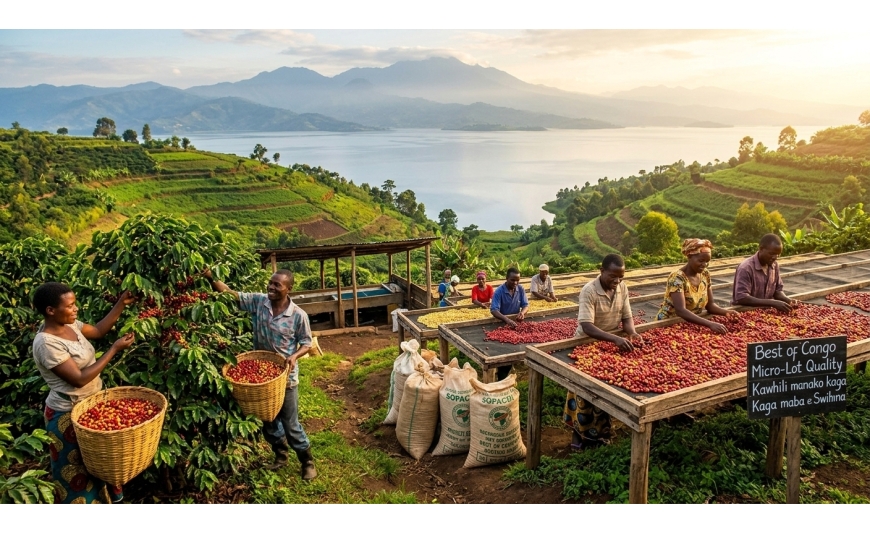
Congo’s Coffee Moment: The Microlots Putting the Democratic Republic of Congo on the Specialty Map
From the shores of Lake Kivu to the slopes of the Rwenzori Mountains, a new generation of Congolese coffees is demanding attention — one exceptional microlot at a time.
For years, the Democratic Republic of Congo has been known internationally for many things.
Its immense natural resources.
Its breathtaking landscapes.
Its complex history.
And, unfortunately, the instability that has affected many communities in the eastern part of the country.
But there is another story emerging from the hills of eastern Congo.
Coffee.
Not simply coffee as a commodity, but traceable, high-quality specialty coffee capable of competing for the attention of some of the world's most demanding roasters.
That story is coming into focus through the Best of Congo Cooperatives, whose third edition is bringing 32 winning coffees from eastern DRC to international buyers — with the highest-ranked microlots heading into a global auction from September 1–3, 2026.
And at the centre of it all is a coffee called Café Izuba.
? A Coffee Origin Still Waiting to Be Discovered
The Democratic Republic of Congo is not a newcomer to coffee.
But in the specialty coffee world, it remains an origin with enormous potential that is still relatively underexplored.
That is exactly what makes the Best of Congo Cooperatives program so interesting.
The initiative, organised by African Coffee Connect and CongoAgri Platform, is creating a bridge between Congolese cooperatives and international green coffee buyers.
The first edition launched in 2024.
Now, three editions later, the message is becoming increasingly difficult to ignore:
Congo can produce exceptional coffee.
And the people producing it want the world to taste it.
? The Coffee at the Top: Café Izuba
The star of the 2026 competition is Café Izuba, an anaerobically fermented coffee from South Kivu.
It scored an impressive 86.19 points, taking first place among the international winners.
Second place went to Muungano Natural, scoring 86.05, while Diba Fully Washed placed third at 85.84.
But Café Izuba is interesting for more than its score.
Its producers, Linda Mugaruka and Moise Dunia Muhindo, deliberately experimented with anaerobic processing — a technique increasingly associated with innovative specialty coffee around the world.
Organisers describe Izuba as the DRC's first anaerobic coffee, making the lot particularly significant for an origin that is still establishing its identity in the specialty market.
The name itself carries meaning.
Izuba means "sun."
For its producers, the name represents life, energy and renewal.
And considering the circumstances in which the coffee was produced, that symbolism feels especially powerful.
☕ When Innovation Becomes Resilience
Creating experimental coffee is not always easy.
In South Kivu, producers have faced difficulties accessing plantations, logistical constraints and increasing pressure on farmer incomes.
In that environment, experimenting with processing is not simply about chasing a higher cupping score.
It is about finding ways to create more value from every kilogram of coffee produced.
That is the bigger story behind Izuba.
The coffee represents an attempt to turn quality and innovation into economic opportunity — allowing producers to capture more value while putting Congolese coffee in front of buyers who might otherwise overlook the origin.
32 Coffees. One Extraordinary Origin Story.
The 2026 Best of Congo Cooperatives program features 32 winning coffees.
Of these:
-
14 international winners are being offered through the auction.
-
18 national winners are available through an offer sheet.
-
The auction takes place on M-Cultivo from September 1–3, 2026.
-
The offer sheet for the national winners closes on September 10.
-
The auction lots range from 86 to 300 kilograms.
-
Bidding begins at US$13 per kilogram, equivalent to about US$5.90 per pound.
-
Purchased lots will be consolidated and shipped to buyers in the United States, United Kingdom, European Union and South Korea.
These are not anonymous bulk coffees.
The program places a strong emphasis on traceability, allowing buyers to understand the cooperatives, producers and production stories behind individual lots.
That matters in specialty coffee.
Because the modern coffee buyer increasingly wants to know not just what is in the cup, but where it came from and who produced it.
? From Lake Kivu to the Rwenzoris
The coffees represented in the program come from cooperatives across eastern DRC.
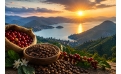
Their growing landscapes stretch from the shores of Lake Kivu towards the slopes of the Rwenzori Mountains.
The result is a catalogue that reflects the diversity of Congolese coffee production.
There are:
Fully washed coffees — clean and structured.
Natural coffees — fruit-forward and expressive.
Anaerobically fermented coffees — experimental, modern and often intensely aromatic.
Together, they demonstrate that Congolese coffee does not have to fit into a single flavour identity.
The origin is still revealing itself.
??? Women, Youth and Batwa Producers Take the Stage
Perhaps one of the most important elements of this year's program is its focus on inclusion.
The 2026 initiative includes microlots produced by women, young people and marginalised Batwa communities, supported through collaboration between African Coffee Connect and UK-based Pact Coffee.
Seven of these community-focused lots are included in the wider 2026 program.
Three have made it into the international auction.
That is significant.
Because specialty coffee is often discussed through the language of scores, processing methods and flavour notes.
But behind every score is a person.
And programmes like Best of Congo Cooperatives are creating opportunities for producers who have historically had limited access to international specialty markets.
? Coffee Grown in the Shadow of Conflict
There is no way to tell the story of eastern Congolese coffee without acknowledging the environment in which many farmers operate.
The region has experienced prolonged conflict, infrastructure difficulties and logistical challenges.
Yet coffee farmers continue to cultivate, harvest, process and improve their coffees.
That resilience is one of the defining characteristics of the Best of Congo story.
As co-founder Richard Hide put it, the farmers are determined not to allow the difficulties they face to define what their coffee can become.
This changes the meaning of a coffee auction.
It is not simply about who bids the highest price.
It is also about creating a route for producers to demonstrate quality, build relationships with international buyers and potentially attract investment into coffee-growing communities.
? Why These Auctions Matter
A specialty coffee auction can do something that conventional coffee trading often struggles to do:
put exceptional quality directly in front of buyers who are willing to pay for it.
For producers, that can mean greater recognition and potentially higher returns.
For roasters, it offers access to coffees that are rare, traceable and distinctive.
For the origin itself, it creates visibility.
And for Congo, visibility may be one of the most valuable commodities of all.
The country is still relatively early in establishing itself as a recognised specialty coffee origin.
Pact Coffee's Director of Coffee and Social Impact, Will Corby, has encouraged more roasters and buyers to taste the coffees and discover what is happening in the country now rather than waiting for Congo's specialty coffee story to become mainstream.
That is an important point.
Some of the world's most exciting coffee origins are not the ones everyone already knows.
They are the ones just beginning to be discovered.
? The Rise of Experimental Congolese Coffee
Café Izuba also points to another important development.
Congolese producers are not simply trying to reproduce what established origins are already doing.
They are experimenting.
Anaerobic fermentation, natural processing and other post-harvest techniques give producers new tools for exploring the flavour potential of their coffees.
And when those experiments succeed, they can create coffees that are memorable enough to attract international attention.
The 2026 results demonstrate exactly that.
The winning table includes anaerobic, natural and fully washed coffees, showing how producers and cooperatives are increasingly using processing as part of their quality strategy.
?? Congo Is More Than Its Challenges
There is a danger whenever coffee from a difficult region enters the international market.
The story can become dominated by hardship.
The conflict.
The poverty.
The infrastructure.
The struggle.
Those realities matter.
But they should not become the entire identity of the coffee.
Because the 2026 Best of Congo results tell another story.
They tell us about farmers who are experimenting.
Cooperatives that are improving quality.
Women and young producers entering international competitions.
Processing innovation.
Traceability.
And coffees scoring above 85 points and competing for the attention of specialty buyers around the world.
The coffee deserves to be judged in the cup — not only by the circumstances surrounding it.
? A New Chapter for African Specialty Coffee
Africa's specialty coffee map has traditionally been dominated by familiar names.
Ethiopia.
Kenya.
Rwanda.
Uganda.
Tanzania.
But the continent's coffee story is much bigger.
Burundi continues to produce remarkable coffees.
Sierra Leone is attracting renewed attention.
Cameroon is exploring its specialty potential.
And now, increasingly, the Democratic Republic of Congo is asking to be part of that conversation.
The Best of Congo Cooperatives auction is not going to single-handedly transform the country's coffee industry.
But it is doing something important.
It is creating a platform.
A platform where producers can be seen.
Where cooperatives can be recognised.
Where buyers can discover new coffees.
And where the world can begin to understand what Congolese coffee is capable of.
☕ The Coffee We Haven't Discovered Yet
Perhaps the most exciting thing about Congo is that the story is still being written.
The 2026 auction is only the third edition of Best of Congo Cooperatives.
There are still producers who have never entered an international competition.
There are still farms whose coffees have never been tasted by European, American or Asian buyers.
There are still processing experiments waiting to happen.
And there are still flavour profiles waiting to be discovered.
That makes Congo one of the most intriguing coffee origins to watch right now.
Not because the journey is finished.
But because it is only beginning.
? At AfricanCoffee.ch, We Believe Africa's Coffee Story Is Bigger Than the Familiar Names
At AfricanCoffee.ch, we believe African specialty coffee deserves to be explored beyond the origins that already dominate the conversation.
The story of Congolese coffee is a powerful reminder of why origin matters.
Behind every microlot is a landscape.
Behind every processing method is a decision.
Behind every cupping score are farmers and cooperatives.
And behind every exceptional cup is the possibility of a new relationship between producer and buyer.
Café Izuba may have taken the top spot in the 2026 Best of Congo Cooperatives competition.
But perhaps the bigger winner is the origin itself.
The Democratic Republic of Congo is showing the specialty coffee world that its best days may still be ahead.
And we will be watching — and tasting — as that story unfolds.
0 Comments